The Future Dominant Role of AUVs in Ocean Operations
Introduction:
Humans and the ocean have always been intertwined, as it has fed us, carried us, and shaped civilizations. But it has never yielded easily. The ocean does not bend to our will, and every descent beneath its surface requires risk, infrastructure, and persistence.
As our ambition grew, so did our reach. We continued to push deeper into the abyss and uncovered ecosystems few had imagined. We mapped undersea mountain ranges, discovered hydrothermal vents alive with biodiversity, and identified mineral resources that could one day power entire industries. Each venture revealed more of the ocean’s secrets, and more of its potential.
Yet through every era of progress, one constraint remained unchanged: ocean operations depended on surface vessels. No matter how deep we explored, we were still tied to ships above and their crews, we were tied to fuel, to mobilization schedules, and costs that scaled directly with time.
Autonomous Underwater Vehicles (AUVs) are beginning to break that constraint. What began as pre-programmed survey tools has evolved into perception-guided systems capable of operating with far less reliance on continuous ship presence. This is more than an incremental improvement; it is a structural shift in how ocean intelligence is gathered.
1.0 A History of Ocean Exploration
For most of history, human presence was the infrastructure of ocean work. Ships carried us across open water; and when diving bells arrived, they extended our time below the surface [1]. SCUBA allowed us to work longer and explore further, and so each advancement pushed the boundary of what was possible.
Then came Remotely Operated Vehicles (ROVs). They removed the need to place humans at extreme depths and enabled precision tasks far beyond human capability, so ROVs remain indispensable today [2]. But while they reduced risk, they did not change the underlying economics. ROVs still require surface vessels, trained crews, and continuous operator control. The ocean floor may be miles below, but the operation is still anchored above.
Early AUVs untethered the vehicle but not the system. They were able to execute pre-programmed missions efficiently, particularly mapping, yet deployment remained vessel-based and episodic [3]. Semi-autonomy did exist, but it did not fundamentally change how ocean operations scaled.
We could go deeper than ever before, but we were still operating within the same economic framework.
2.0 The Inflection Point
AUVs remained a supporting tool within ocean operations for decades, but they never played a dominant forward-facing role until recently. This shift has been driven by several factors.
2.1 An Economic Inflection Point
Surface vessels are expensive by nature. Fuel, crew, maintenance, and charter rates quickly drive daily costs into the tens or hundreds of thousands of dollars [4]. Most importantly, these costs scale linearly with time. More monitoring requires more ship days, and more ship days require more capital.
This model works for small campaigns, but it does not scale well for long-term monitoring surveys. Modern AUVs change that equation, as by reducing continuous human-in-the-loop control and extending operational endurance, they decouple data collection from constant vessel presence. And so, the cost per hour of subsea data begins to decline [5]. That shift is not incremental; rather, it changes what becomes economically feasible.
2.2 Technological Enablers
The past decade alone has completely changed the way this can be accomplished. Advancements have been made in each area needed for AUVs to be a legitimate industry including artificial intelligence, lithium-ion batteries, and edge computation.
AI models are now capable of real-time object detection. Models can be trained for certain environments and can now detect objects relevant to their mission and detect differences in their environment as well [6]. Simultaneously, AI models can adapt missions on their own; they can follow the same parameters but make necessary adjustments to complete their mission without failing if something goes awry [7] (unlike early AUVs who relied on pre-programmed objectives).
Lithium-ion battery technology has advanced significantly over the past decade. Long-range electric vehicles now dominate year-over-year growth in new car sales [8], driven by improvements in energy density, cycle life, thermal management, and battery management systems [9] (BMS). These same electrochemical and systems-level advancements are directly transferable to AUV platforms. Higher energy density enables longer mission endurance, while improved charge–discharge durability and safety allow for more reliable, repeatable deployments in demanding subsea environments.
3.0 From Useful to Dominant
Throughout history, technologies only become widely adopted when they meet certain conditions: they lower marginal cost, scale without proportional labor, and remove a core operational constraint.
For decades, AUVs were useful additions to ocean operations. They improved mapping efficiency and reduced operator involvement, but they remained embedded within vessel-based campaigns. They enhanced the system; but they did not change it. What changes now is economic feasibility. Systems that rely on ships have a cost that scales linearly with time. More monitoring requires more ship time, and more ship time requires more fuel, more pay for the crew, and more advanced logistics [4]. This makes long-term or continuous monitoring economically difficult, even when technically possible. Modern AUV systems begin to disrupt that relationship.
Advancements in autonomy reduce the need for constant human oversight. Improvements in battery energy density extend mission duration. Onboard processing allows vehicles to interpret and prioritize data without transmitting everything to the surface [3,9]. When these capabilities converge, subsea data collection no longer has to be directly tied to continuous vessel presence.
This is where dominance begins to emerge. Longer-duration deployments, and eventually resident architectures, allow monitoring to become persistent rather than episodic. Instead of mobilizing ships for discrete campaigns, autonomous systems can remain in-region for extended periods, gathering continuous intelligence [10]. Several emerging companies are now exploring resident architecture that allow AUVs to remain deployed for months at a time.
Persistence changes values. Environmental baselines deepen, and infrastructure inspections become routine rather than reactive. Data compounds over time instead of resetting between missions, and so AUVs are no longer simply improving surveys; they are beginning to redefine how ocean operations scale.
4.0 The Market Expansion
While exact projections vary, one reality remains consistent: the AUV market is already a multi-billion-dollar industry and is projected to expand rapidly over the next decade. This growth reflects demand across defense, offshore energy, and subsea infrastructure.
4.1 Defense
Defense represents the largest share of current AUV revenue, roughly controlling 42.4% of the market by 2026 [11]. As maritime domains become increasingly strategic, navies are investing in autonomous systems for intelligence, surveillance, reconnaissance, mine countermeasures, and anti-submarine operations.
Autonomous platforms reduce risk exposure while expanding operational reach. As geopolitical tensions rise and naval competition intensifies, reliance on autonomous underwater systems is expected to deepen.
4.2 Offshore Infrastructure
Subsea cables, offshore wind farms, and oil & gas installations represent massive capital investments beneath the surface. These assets require routine inspection and monitoring to maintain reliability and safety [11,12].
As offshore development moves into deeper waters, vessel-based inspection models become increasingly expensive. AUVs and unmanned surface vehicles provide more repeatable, lower-cost monitoring alternatives, enabling higher inspection frequency without proportional increases in operating cost [12].
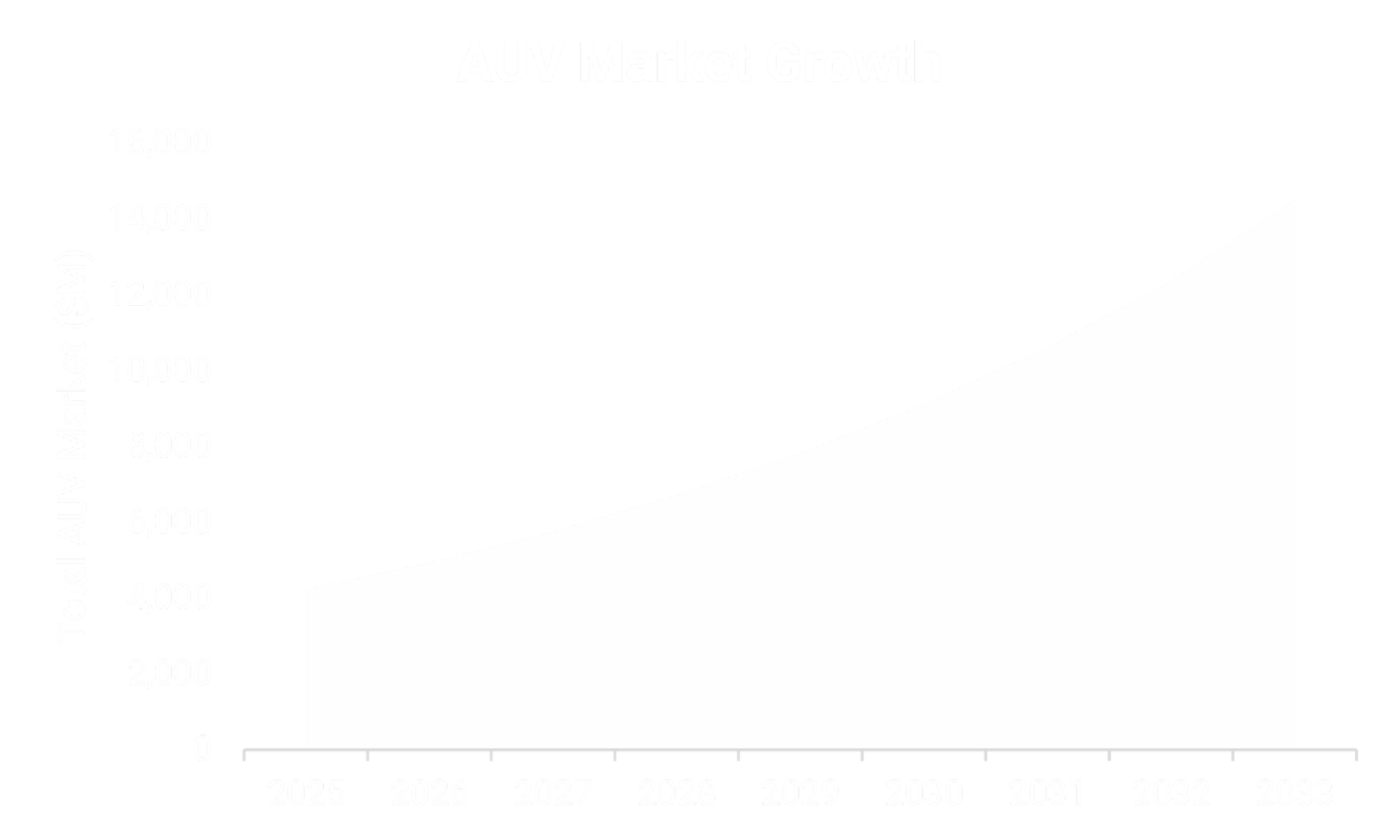
Figure 1. The AUV market is expanding rapidly as offshore industries increasingly rely on autonomous systems for subsea mapping, inspection, and data collection.
Overall, the AUV market is currently worth approximately $4.23 Billion, and is expected to hit $14.51 Billion by 2033, with a CAGR of 16.64% from 2026 to 2033 [12]. The AUV market is a rapidly expanding one, due to the future dominant role AUVs will play in ocean operations
5.0 Implications for Deep-Sea Mining
Deep-sea mining faces both economic and regulatory scrutiny. Environmental baseline surveys are required before commercial extraction, such as in the Clarion-Clipperton Zone (CCZ), where biodiversity varies significantly across contract areas requiring a multitude of surveys to hopeful prospectors [13].
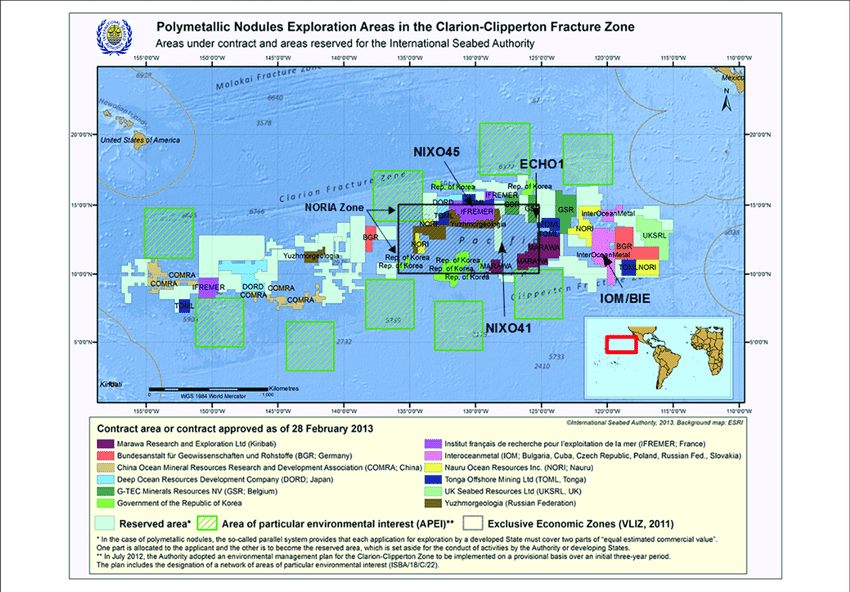
Figure 2. Exploration contract areas in the Clarion-Clipperton Zone (CCZ). Source: Tilot et al. [15], licensed under CC BY 4.0.
These surveys are vessel-intensive and often span years, costing companies millions to conduct [14]. During extraction, ongoing environmental monitoring is required to measure sediment plumes and ecological impact. Autonomous systems offer a path toward long-term monitoring, with reduced operational burden. Rather than relying solely on periodic vessel campaigns, long-duration AUV deployments could provide more continuous environmental data.
For an industry navigating environmental concerns, persistent monitoring infrastructure could improve transparency, oversight, and defensibility.
Conclusion:
AUVs have evolved from supplementary survey platforms into systems capable of reshaping ocean operations. Enabled by advances in autonomy, endurance, and onboard computation, they are positioned to reduce continuous vessel dependency and lower the marginal cost of subsea intelligence.
As missions transition from episodic deployment to persistent presence, data collection becomes scalable. Intelligence will continue to compound, which causes the current operational model to shift. Across defense, offshore infrastructure, research, and potentially deep-sea mining, AUVs are moving from the sidelines toward the core of ocean operations.
The question is no longer whether AUV adoption will expand. The question is how quickly vessel-dependent operations become the exception rather than the rule.
Citations:
[1] B. Emley, “How the diving bell opened the ocean's depths,” The Atlantic, Mar. 23, 2017. [Online]. Available: https://www.theatlantic.com/technology/archive/2017/03/diving-bell/520536/. Accessed: Mar. 4, 2026.
[2] National Oceanic and Atmospheric Administration, “What is an ROV?” NOAA Ocean Explorer. [Online]. Available: https://oceanexplorer.noaa.gov/ocean-fact/rov/. Accessed: Mar. 4, 2026.
[3] R. B. Wynn et al., “Autonomous underwater vehicles (AUVs): Their past, present and future contributions to the advancement of marine geoscience,” Mar. Geol., vol. 352, pp. 451–468, 2014. doi: 10.1016/j.margeo.2014.03.012.
[4] Japan Agency for Marine-Earth Science and Technology, “Research vessels and submersibles.” [Online]. Available: https://www.jamstec.go.jp/e/about/equipment/fee/. Accessed: Mar. 4, 2026.
[5] Business Norway, “Argeo’s AUV robotics de-risks offshore wind projects.” [Online]. Available: https://businessnorway.com/solutions/argeo-auv-robotics-de-risks-offshore-wind-projects. Accessed: Mar. 4, 2026.
[6] M.-F. R. Lee and Y.-C. Chen, “Artificial intelligence-based object detection and tracking for a small underwater robot,” Processes, vol. 11, no. 2, p. 312, 2023. doi: 10.3390/pr11020312.
[7] E. Kwan et al., “Onboard mission replanning for adaptive cooperative multi-robot systems,” arXiv:2506.06094, 2025. doi: 10.48550/arXiv.2506.06094.
[8] International Energy Agency, Global EV Outlook 2025: Trends in electric car markets. [Online]. Available: https://www.iea.org/reports/global-ev-outlook-2025/trends-in-electric-car-markets-2. Accessed: Mar. 4, 2026.
[9] K. R. Ngoy et al., “Lithium-ion batteries and the future of sustainable energy: A comprehensive review,” Renew. Sustain. Energy Rev., vol. 223, p. 115971, 2025. doi: 10.1016/j.rser.2025.115971.
[10] One Ocean Network for Deep Observation, “Resident AUV.” [Online]. Available: https://www.onedeepocean.org/Activities/Technological-Innovation/Resident-AUV. Accessed: Mar. 4, 2026.
[11] Fortune Business Insights, “Autonomous underwater vehicle market.” [Online]. Available: https://www.fortunebusinessinsights.com/autonomous-underwater-vehicle-market-105907. Accessed: Mar. 4, 2026.
[12] SNS Insider, “Autonomous underwater vehicle (AUV) market.” [Online]. Available: https://www.snsinsider.com/reports/autonomous-underwater-vehicle-auv-market-2050. Accessed: Mar. 4, 2026.
[13] International Seabed Authority, Building robust deep-sea environmental baselines: A foundation for sustainable mineral resource management, Policy Brief, 2025. [Online]. Available: https://isa.org.jm/wp-content/uploads/2026/01/ISA-Environmental-Baseline-Policy-Brief-SSKI_2025.pdf. Accessed: Mar. 4, 2026.
[14] Impossible Metals, “How much does it cost and how long does it take to run the EIA program for deep-sea mining?” [Online]. Available: https://impossiblemetals.com/blog/faq-items/how-much-does-it-cost-and-how-long-does-it-take-to-run-the-eia-program-for-dsm. Accessed: Mar. 4, 2026.
[15] V. Tilot, R. Ormond, J. Navas, and T. Catalá, “The benthic megafaunal assemblages of the CCZ (Eastern Pacific) and an approach to their management in the face of threatened anthropogenic impacts,” Frontiers in Marine Science, vol. 5, 2018. doi:10.3389/fmars.2018.00007.
