Technology
Casper: a new way to monitor subsea infrastructure.
Casper is an autonomous underwater vehicle that inspects subsea infrastructure on a recurring schedule and reports the findings that matter. Operators get continuous coverage of their cables and foundations without waiting for the next survey vessel.
Status
TRL 4
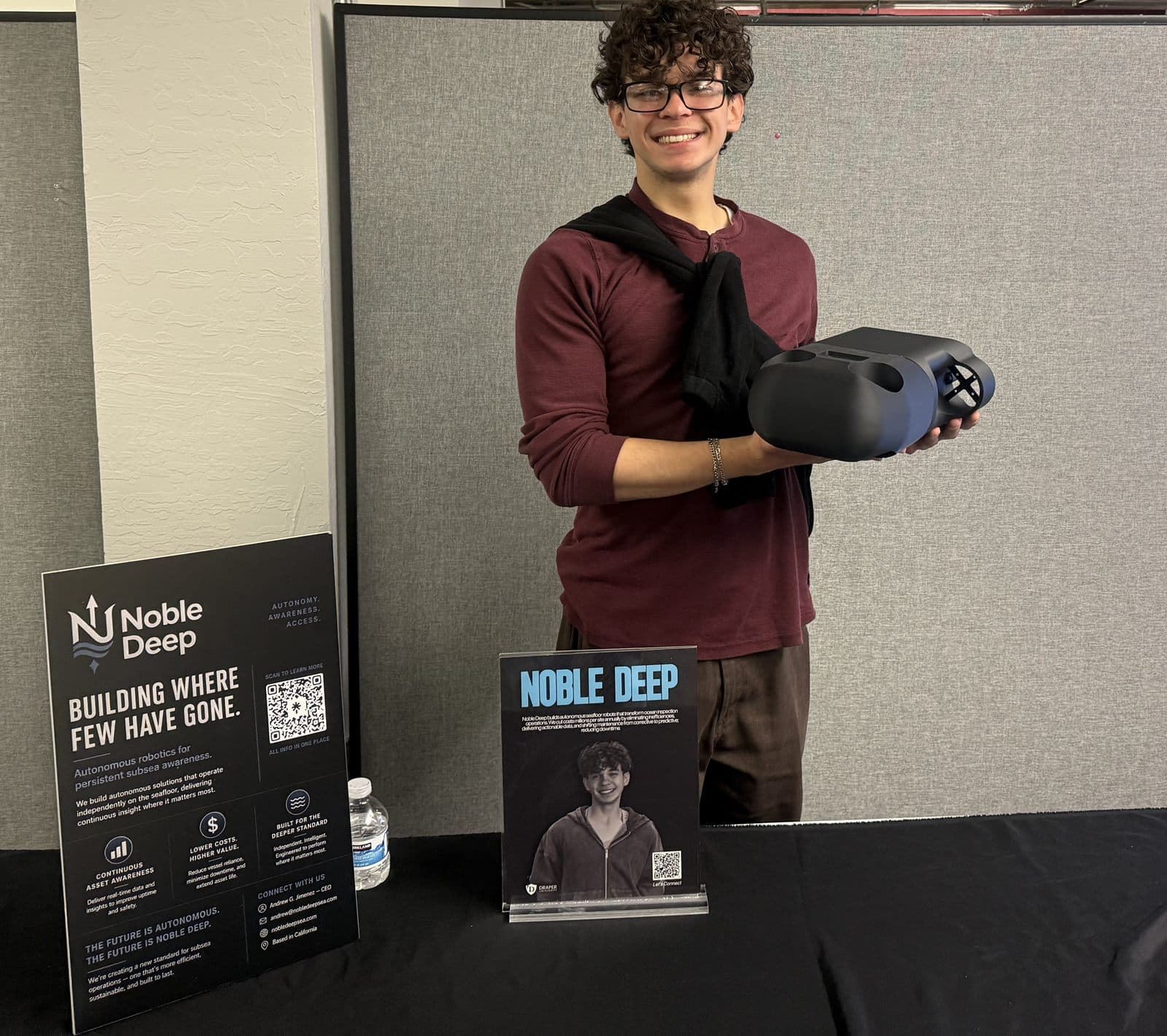
Current stage: TRL 4. Sub-components integrated and tested together on the bench. Casper Rev.1, our first integrated vehicle, is in build.
01Operating Cycle
Survey, detect, report, and repeat.
- 01
Survey
Casper navigates pre-planned inspection routes along the asset, holding depth and position with sensor-fused navigation.
- 02
Detect
Onboard edge compute processes the inspection data in real time and flags anomalies, each tagged with its position on the asset.
- 03
Report
Findings go to the operator's engineering team as a structured condition report.
- 04
Repeat
Inspections recur on schedule or on demand, building a long-term record of how the asset and seabed change.
Deployment and recharging architecture withheld pending IP protection.
02Specifications
Casper: Design Targets
- Depth rating
- 300 m rated, typical operating range ≤100 m
- Per-mission endurance
- Pending
- Total vehicle weight
- Pending
- Navigation & positioning
- IMU, DVL, GPS surface fix, acoustic positioning, sound velocity profiler; sensor-fused pose estimation
- Inspection payload
- Optical and acoustic inspection sensors, cathodic-protection probe
- Onboard compute
- Edge AI for mission management, obstacle classification, and anomaly detection
- Communications
- Fully autonomous during missions, with no tether.
Casper is in active development. Confirmed values replace targets as validation progresses, and “Pending” marks values we won't publish until they are measured.
03Autonomy
Validation status
Casper runs a predefined inspection mission in simulation today, with path planning, depth hold, and mode switching working. We're now building the autonomy layer, which lets the vehicle decide what to do rather than follow a fixed plan.
04What an Operator Receives
Findings, not footage.
GPS-tagged anomaly location
Every flagged anomaly is delivered with its georeferenced position on the asset, so follow-up crews go straight to the finding.
Supporting imagery
Visual evidence for each finding, with before/after comparison where prior-mission data exists for the same location.
Structured summary
A condition report formatted for hand-off to the customer's own engineering or asset-integrity team for review and sign-off.
05Safety & Fault Handling
Designed for unattended operation
Casper is designed to run without an operator watching. An always-on fault-supervision layer independently monitors for leaks, collisions, and loss of communications. When it detects a fault, it safes the vehicle and preserves mission data onboard.
06Progress
What's done, and what's in progress.
Complete
- Benchtop build, with thrusters bench-tested
- Vehicle hull, electronics enclosure, and thruster models designed
- Buoyancy and ballast calculations
- Vehicle communication and control software
- Data logging requirements defined
- Inspection mission running in simulation: path planning, depth hold, mode switching
- Invited to attend the Spring 2026 Draper University cohort
- Finalist, Ocean Exchange 2026 Collegiate Awards
In progress
- Casper Rev.1 vehicle assembly
- Onboard autonomy layer
- Customer discovery across the offshore wind buying chain
Become an early partner.
We're selecting 2–3 early partners to shape Casper's validation program.